Thứ Tư, 16 tháng 12, 2015

2015 Year in Review

2015 was a year with new and exciting AdSense updates. Let’s have a look at 2015 to recap all the product enhancements launched this year.


New features for your AdSense account:


  • New sign-up flow: Signing up for AdSense is now faster and easier. Now, you have immediate access to your AdSense account once you sign up for AdSense.
  • New AdSense website and mobile apps: We announced our new AdSense website with a new design and new publisher stories. We also updated the AdSense app with a fresh new look using material design and added some new features. 
  • New AdSense performance reports: To give you quick and easy access to these reports, we introduced a new design for AdSense reporting with a new dashboard. With the redesigned Performance reports tab, you now have more control and flexibility, allowing you to better understand your AdSense earnings and performance.
  • Improved transparency in payments: We've received feedback from you that you want to know more about the differences between estimated and finalized earnings. Now, you’re able to see the invalid activity deductions that cause these differences. 
  • Matched content: To help you grow the number of pageviews on your site and increase user engagement, we launched Matched content. It’s a free content recommendation tool that promotes your content to your site visitors. Matched content generates contextually relevant and personalized article recommendations from the pages on your website. Have a look at the site management settings in your AdSense account to see if your sites are eligible to run Matched content.

New features for your ads: 


  • New mobile text ads: This new design allows for higher performance with a more beautiful and user-friendly appearance. The text ads feature elements such as a shaded background and a centered button which bring together the parts of the ad into a cohesive whole. To see these new mobile text ads, choose to show both text and display ads on your site, if you haven’t already done so.
  • Richer text ads: Richer text ads are a new ad format that automatically creates image ads from text ads. They compete for both your text and display, and display-only ad units and could increase your earnings.
  • Improved "Mute this ad" feature: With ‘Mute this ad,’ users have a way to signal that they aren’t interested in certain ads. This feature gives users additional control over ad units. It also helps us find ad placements and creatives that users may not prefer so that we can continue working hard to serve better performing ads on your site.

We’re looking forward to 2016 with lots of new features and formats to improve your AdSense experience.

As always, we’d like to thank you for sharing your feedback. Please keep sharing your thoughts and suggestions and stay tuned for more updates in 2016.

Happy New Year, and see you online in 2016!

Google AdSense Team
Not yet an AdSense user? Sign up now!

Thứ Ba, 15 tháng 12, 2015

Can't log in? Here's how to solve the five most common issues

Not being able to log in to your account can be frustrating, and it happens to most of us now and then. Every week the AdSense support team receives emails from publishers who are logged out and stumped.

With that in mind, let's look over the five most common "can't log in" scenarios and how you can clear them up and get back into action.

1. The email and password you entered don’t match

This is always the #1 login issue. Luckily, a fix is just few clicks away. If you've run out of all your memory tricks for remembering your password, visit Google's account recovery service. Enter your login address to reset your Google account password.

2. You deleted your Google Account

Your AdSense account is linked to other Google services like Gmail, Calendar, and Google+ under one Google Account. Sometimes a user decides to delete one service and deletes their entire Google Account, which cuts off access to their AdSense account as well. The good news: even if you deleted your Google Account and lost access to AdSense, your AdSense account is still active. To continue using AdSense, you'll need to recover your Google Account.

3. Your account was hijacked

Hijacking is more common in some regions than in other. If you think your account has been hijacked, you need to act fast.

First things first, visit this page and follow the instructions to alert a Hijacked Accounts specialist and prove your ownership. Be sure to provide detailed and accurate information for each of the questions. Next, contact the AdSense support team by following the steps in the Login troubleshooter. This will let us restore your access to your AdSense account.

To prevent hijacking from happening, follow these security best practices:
  • Enable 2-step verification 
  • If you sign into your account from a public computer, make sure to log out when you're done
  • Don't share your password with others and don't write it down on paper or in documents
  • Use strong passwords. The strongest contain upper and lower cases, special characters, and numbers, like this:  “mYvErY234Strong_pAssWord”
  • Change your password frequently 

4. You signed into a different Google Account 

If you have more than one Google Account, your AdSense account will be linked to only one of them. If you're signed in but don't see your AdSense account, you may be signed into a different Google Account. Try logging in with a different email and password.

5. Your Google Apps account is not opted in for AdSense

If your email is linked to Google Apps, the Google Apps administrator might have turned off AdSense service for the whole Google Apps account. To fix this, ask your domain administrator to grant you access for AdSense. You can contact Google Apps support if you have more questions.

Now let's hope you never need any of these. For more information, check the AdSense Help Center.

Not yet an AdSense user? Sign up now!


Posted by Kateryna Malinovska
AdSense and AdMob Support Program Manager

Thứ Sáu, 11 tháng 12, 2015

Got Policy Questions, “Ask the AdSense Guy”

As part of our continued effort to be as transparent and accessible to publishers as possible, we’ve launched a collaboration with Search Engine Journal with a column titled “Ask the AdSense Guy”.

In this monthly column, we’ll answer questions on topics of interest from the readership of the Search Engine Journal, as well as provide insight into best practices for publishers of all sizes. Our hope is that these external collaborations strengthen overall understanding of our policy positions and allow publishers to scale their long term growth in ways that provide value for their users, as well as advertisers who place ads on publisher sites.

A Search Engine Journal managing partner, Brent Csutoras, interviewed me at Pubcon 2015 to get a glimpse of what investments Google is making to help the entire ecosystem: users, advertisers, and publishers.  Follow our column and share your questions, or submit them as a comment below.  We will answer questions posted on Search Engine Journal, as well as those we collect from our comments section and will post them in the “Ask the AdSense Guy” column.


Posted by John Brown
Head of Publisher Policy Communications

Chủ Nhật, 5 tháng 7, 2015

XP and Alignment

Idea #1 - XP for rescue and assistance

Maybe rescuing someone from the clutches of the bad guys ought to be worth some XP.  100xp per level of the person rescue might be a good starting benchmark.  Count low level but important people as higher level for purposes of this calculation.  (E.g. the richest merchant in the land might be a 1,000 point rescue, even though he's a 3 level chump.)  Whether this XP is in addition to or in lieu of XP for reward money is up to the stinginess of the DM.  If the PCs mistreat or further endanger the poor wretches, XP ought to be reduced.

"Assistance" is worth half as much as rescue, and could be interpreted broadly.  Help a treant find the missing piece to the 5,000 piece puzzle he's spent 150 years trying to complete would be worth treant HD x50.

Idea #2 - XP multipliers by Alignment

Lawfuls - Double XP for rescue and assistance, double XP for chaotics defeated (suddenly, a reason to be lawful!), half XP for lawfuls defeated

Neutrals - Double XP for treasure, double XP for any monster defeated by non-combat means

Chaotics - Double XP for Lawfuls defeated, double XP for any treasure not split with other party members

Obviously all this doubling is going to speed up advancement.  More importantly, by giving characters different goals it forces the party to negotiate over why the heck they are even in the dungeon.

Thứ Năm, 25 tháng 6, 2015

Overclock Your Damage


This is one of those ideas so simple, I'm certain someone else came up with it.  Maybe I read it and forgot about it.

So in many D&D versions, both official and house-ruled, there's this weird thing when you roll one number to see if you hit the orc and another to see if you chop its fool head off.  This means you can end up with a range like this:

1 ... Miss! (maybe it's a fumble if the DM is cruel)
2-11 ... Miss!
12-17... I hit!  Alright!
18-19 ... Argh!  So close to a critical!
20 ... Yeah, baby!  This orc is toast!

That 18-19 range is my concern today, or really any number that's less than a critical but well in excess of the minimum needed to hit.  Tom Moldvay tried to smooth out the transition from normal hit to uber crit by adding in a chart of extra effects.  What I'm about to propose here gets you an extra effect for a better hit while dispensing with the rigamarole of tracking who is carrying what penalties to their actions.

In BX all standard weapons do d4, d6, d8 or d10.  That's a 2 point jump in max damage for every die size increase.  So here's my basic idea: for every 2 points you exceed to to-hit target, bump your die up one size.  If applied to the monsters as well that's going to make it easier for high hit die monsters to mangle the PCs.

Before trying this one would need to set the maximum die size.  You could cap it at the largest die actually in use for weaponry, the d10.  That means under the right circumstances a dagger is as lethal as a polearm, but nothing is actually more deadly than the normal standards of BX play.  Alternatively, you could use this rule as a low-complexity, high-damage alternative to crit rolls by allowing the max die size to get ridiculous.  There are many more possibilities once you decide you're not bound by the notions of propriety held by mere mortals:

  • d10 becomes d12 becomes d20
  • d10 becomes d12 becomes d20 becomes d30
  • d10 becomes d12 becomes d20 becomes d30 becomes d100

Or use some funky dice like the DCC rpg folks. The sequence d10 -> d12 -> d14 -> d16 follows the +2 max damage progression, but you could always tack on -> d20 -> d24 -> d30 -> d100 for extra insanity.

Easy to implement (if you can subtract the actual roll from the target roll) and your players will love it (until it kills them).
(I will readily admit to not actually knowing the technical definition of the term "overclock.")

Thứ Tư, 24 tháng 6, 2015

Loosening up on BX Race-as-Class


Over on the Google Plus fellow traveller Paul Schaefer asked me an interesting question and with his permission I'm going to answer it here rather than in a private discussion:
As a Basic D&D DM, since it has race as class, what do you do if a player wants to play a race but also wants to use a weird class from another source such as Arduin, Field Guide, Arcanum, or what have you?
Do you just sort of eyeball it, try to balance the race and class abilities?
There are several strategies a BX Dungeon Master can employ when a player makes this sort of request.  Which one you use depends largely on your comfort level and your vision for the campaign.

Option 1: Just Say No

As I was just discussing with Jeffro Johnson, there's nothing wrong with insisting that this is a game with a specific ruleset and all dwarves, elves, and halflings follow the same simple rules. You've got to run the darn thing, so you're responsible for deciding when the rules as written will bend. Rather than go the typical route of class/race editions, where you hang your hat on being a Halfling Sewer Assassin or Dwarf Poisonmage or Elf Tree Idiot, the way one distinguishes oneself in such a game is to play the Best Damn Halfing Ever, The Most Memorable Dwarf We Ever Encountered, That One Elf Who Didn't Suck, etc.

Option 2: Add Race to the Class

Under this scheme the class is the basis for the rules pertaining to the character.  Adding the race selection only grants the character two things, 1) the items listed under the relevant SPECIAL ABILITIES on pages B9 and B10 and 2) the race-based saving throws.

Modify they experience needed for second level for the class using the chart below, then recalculate the rest of the chart.

Demi-Human Costs for Weirdo Classes
Halfling ... +150xp
Dwarf ... +250xp
Elf ... +250xp

Elf would be little higher than dwarf, but I'm assuming the level racial caps (H9, E10, D12) are in play.

You can use this for the standard classes as well, if you need something like a Dwarf Cleric or Halfling Thief.  In fact, since it's so popular an option, here's my proposed chart for the latter combo.

Halfling Thief XP chart
1st level ... 0xp
2nd level ... 1,350xp
3rd level ... 2,700xp
4th level ... 5,400xp
5th level ... 10,800xp
6th level ... 21,600xp
7th level ... 43,200xp
8th level ... 80,000xp

Note that I rounded the XP amount for 8th level down slightly, as in the original chart.

This option ought to work well if you've got a clear understanding of the new class and how it will impact your game.

Option 3: Add Class to the Race

So you've decided you're going to allow a Halfling Techno or a Dwarf Alchemist or Elf Bounty Hunter.  In this option, you start with the Race-As-Class as your basis and layer on freakish class abilities. Keep the hitdice, saves, special abilities, and attack progression of the default race.  Look at whatever the weird class needs to get to level two.  Subtract 1,200 from that amount.  Why 1,200?  That's what thieves need for second level, the canonical BX class with the fastest progression.  (Because they suck.)

Add this amount to the figure for the dwarf, elf, or halfling in question and recalculate.  For example, say you got a player who wants to be a Halfling who is also an Arduin-style Merchant.  According to the original Grimoire, a Merchant needs 2,250 XP for second level, or 1,050 XP over the thief horizon.  The XP chart for a Halfling Merchant would look like this:

Halfling Merchant XP Chart
1st level ... 0xp
2nd level ... 3,050xp
3rd level ... 6,100xp
4th level ... 12,200xp
5th level ... 24,400xp
6th level ... 48,800xp
7th level ... 97,600xp
8th level ... 200,000xp

The result is a character that follows all the Halfling rules and gets all the special abilities of a Merchant.  Note I used a little judicious rounding for 8th level, just like the normal halfling chart on page X6.  Only I rounded up because I'm a jerk.

You may also want to drop some features of the base to bring down the XP totals a bit.  I'm thinking particularly of curtailing the ability to wear heavy armor (halflings in plate mail have always irked me anyone), the wide weapons choices, and possibly elvish spellcasting.  Do the math for second level as above, then modify according to this handy-dandy chart I just made up:

Discounts for Surrendered Abilities
No Plate ... -50
No Plate or Chain ... -100
No Armor ... -200
Restricted Weapons ... -75
No Spells (elves only) ... -1,000

By "limited weapons" I mean something comparable to the cleric's lame selection.  If it's more like a magic-user's lame selection, double the discount.  Note that those numbers may seem small, but they will really add up as the XP needed doubles from level to level.

This option will probably end up costing the PC more in terms of XP needed for progression.  But if its a weird class and you aren't sure how its going to interact with the BX demihuman rules then it may be a good thing to put the brakes on a little bit.

Option 4: Build it From Scratch

Paul Montgomery Crabaugh's article "Customized Class: How to Put Together One-of-a-Kind Characters" from Dragon #109 (pages 8, 10-13*) is my go-to source for puttering with BX classes.  In recent years at least two people have put work into improving Crabaugh's method.  One is my buddy Nick on his blog Of Dice and Djinn.  He's also built a crapton of cool classes using his system.  Perdustin over at Thoul's Paradise has also written at least four articles tackling the subject.  Both those blogs have great titles, by the way.  (True fact: I almost called this blog "The Half-Orc's Lair," quoting from Uncle Gary for the tagline "Half-Orcs are boors.  They are rude, crude, crass, and generally obnoxious." (DMG 16)  But then I realized that would only encourage me to act like a jerkbutt on the internet.  So I put my real name at the top instead.)

Option 5: Go Find Your Class

This option eschews fiddling with XP and instead turns the whole problem into a quest.  "You want to be a dwarf alchemist?  Fine.  You start out as a regular, well-adjusted dwarf.  Now find an alchemist who will take you on as an apprentice."  This option works really great if you're playing in a big sandbox.  Just pick a few places where the PC might be able to get the training they want, then sprinkle the map with a few more places that have leads for the PC.  Then once they find an alchemist (or whatever) willing to take them on, the PC has to finish another adventure to Prove They Are Worthy.

At that point, award the PC with the abilities of a first level whatever-it-is.  Then every time they gain a new level in their regular gig they also have to complete a side quest assigned to them by Master Yoda to also level up in the new class.

Option 6: Ignore the Problem

Not a terrible option for games with a good PC body count.  An elf with berserker abilities/berserker with elf abilities isn't that much harder to murder at 1st level than an elf or a berserker.  At least if you try hard enough.


*Page 9 of Dragon #109 is a full page ad for the global throwdown simulator Supremacy.  Never played it, but I always loved the fact that it came with tiny plastic mushroom clouds.

Thứ Ba, 23 tháng 6, 2015

passing remarks on giants

One of the things I’ve always found interesting about the BX/AD&D1 split is that the monsters aren’t quite the same.  A few iconic D&D monsters don’t appear in BX, such as the beholder, while the BX lineage has a few weirdoes of its own, such as the thoul.  Then there are the cases where the monster looks the same, but there are striking differences if you look closely.  One example of this case is the shadow.  In AD&D a shadow is an undead.  In BX it is not.  With its ghostly creepiness and Strength drain attack it sure as hell looks like undead, but the damn thing can’t be turned.

Another case where first edition AD&D and the 1981 Basic/Expert rules diverge is the way giants are described.  I don’t use a lot of giants in my D&D games, except for the two or three times I’ve run the classic module series G-1-2-3 Against the Giants.  But today I want to attempt to nail down the differences, particularly the non-mechanical ones.  I don’t care that much that an Expert set Hill giant has 8 hit dice while the Monster Manual version has 8+1-2 points, or that an MM fire giant has a point better AC.


HILL GIANT
Expert rules p. X32
Monster Manual pp. 44-45
Height
12’
10½’
Description
stupid, hairy brutes
reddish brown skin, brown or black hair, red-rimmed eyes
Equipment
animals skins, clubs, spears
hides/skins, any weapon but favor clubs
Allies
none
dire wolves, giant lizards, ogres
Other
no mention of stone-throwing
throws stones like all other giants

In my mind Hill Giants have always been oversized neanderthals, and I think much of the art in the hobby (illos and minis) bears this out.  I’d be more inclined to paint a hill giant honky white rather than reddish brown, but that has as much to do with Ringo Starr in Caveman as it does to any hard data.  The MM line about hill giants using “any form of weapon available” makes me want to give one a laser cannon sometime.


STONE GIANT
Expert rules p. X32
Monster Manual pp. 44-45
Height
14’
12’
Description
grey, rock-like skin
grey to grey-brown skin, dark-grey to blue-grey hair, metallic silver-steel eyes, rock-colored garments
Equipment
stalactite clubs
stone weapons
Allies
cave bears
cave bears
Other
May live in crude stone huts.
Why are these guys bald, anyway?
Seriously, have you ever seen a stone giant with hair?  What is the deal with that?

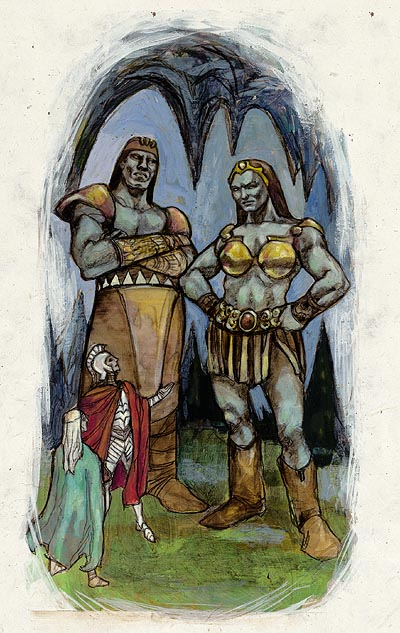
Uncle Gary’s MM description includes greyish or bluish hair, but I can only think of maybe two cases where I saw a stone giant that wasn’t a chromedome:

I think that’s from a Forgotten Realms product, but what I know is that those giants are BAD ASS.  

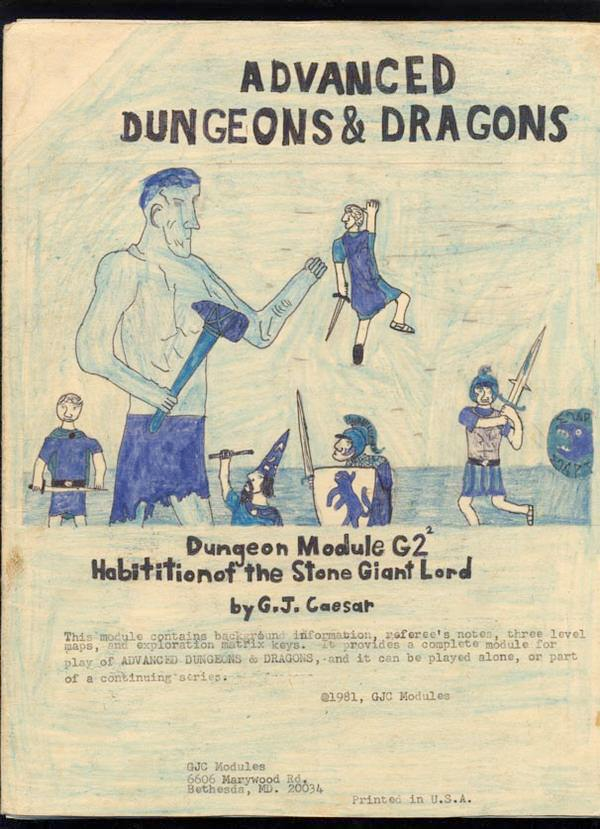
Here’s the only other stone giant I know who doesn’t suffer from male pattern baldness.
You can check out that adventure here, by the way.

Final thought on stone giants: If you run BX and your overland map lacks a quaint pastoral village of 14’ tall rock people living in stone-thatched huts then you need to rethink your life decisions.

FROST GIANT
Expert rules p. X32
Monster Manual pp. 44-45
Height
18’
15’
Description
pale skin, light red or blue hair, full beards
dead-white or ivory skin, blue-white or yellow hair, pale blue or yellow eyes
Equipment
furs and iron armor
as per “northern barbarian”
Allies
polar bears, regular-type wolves
winter wolves
Other
live in castles
live in castles or caverns

These guys are my favorites, because they are totally Giant Sized Marvel Hella Vikings #1.  What is not to like?  The only thing missing from the official description is the known scientific fact that in midwinter these guys ride giant longships to plunder villages along the southern coasts.

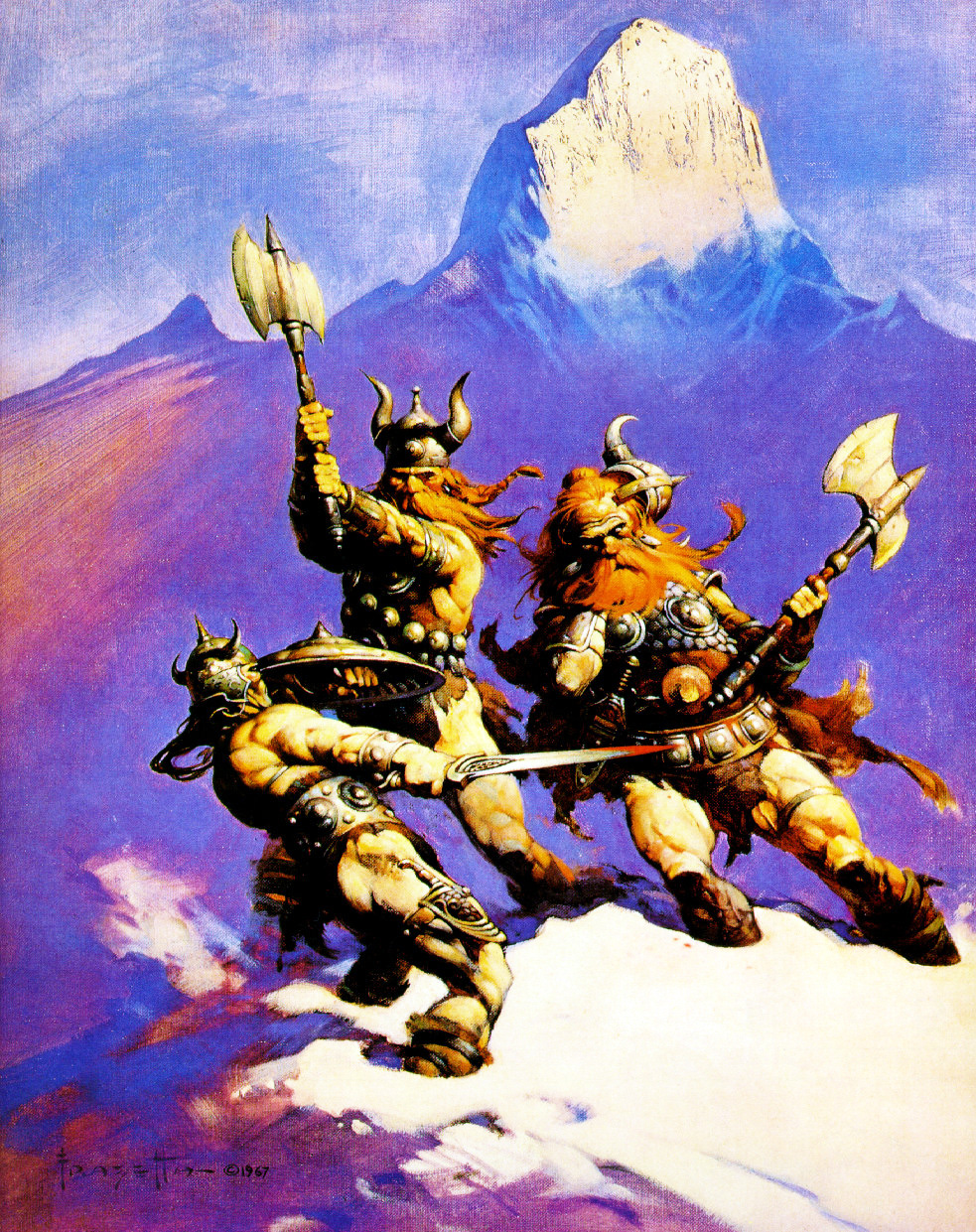
Here’s my alltime favorite depiction of frost giants:
e0ecdf93a5eda23b7c9a899955ff3e173163a7d8
Awww, yeah.  That’s the stuff.  My love for the work of Erol Otus is undying, but who’s betta than Frazetta?  NO ONE THAT’S WHO.

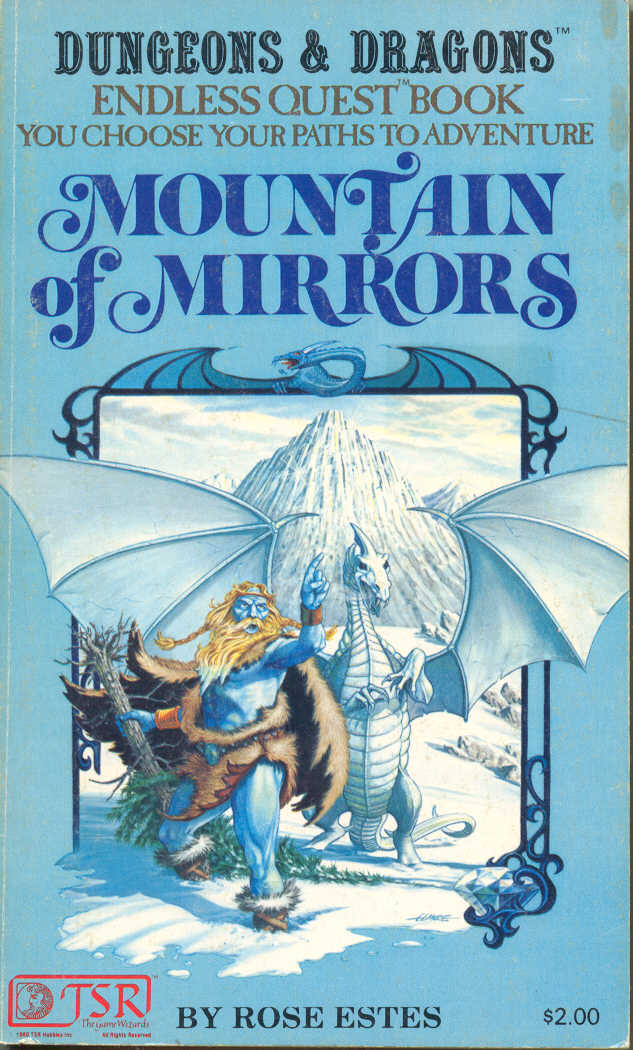
Here’s a neat alt-version of frost giant coloration, unsupported by the canon.
Gotta say I’m digging that pale blue skin.  (Warning: Do not read any D&D books by Rose Estes unless you are a fan of stuff that sucks.)

FIRE GIANT
Expert rules p. X32
Monster Manual pp. 44-45
Height
16’
12’
Description
red skin, dark black hair & beards
broad like dwarves, coal black skin, flaming red or bright orange hair, deep red eyes, yellow orange teeth
Equipment
copper, brass or bronze armor
armor or dragon hides, huge swords
Allies
hydras, hellhounds
hellhounds
Other
dwell in low thick-walled castles of black baked mud reinforced with iron
dwell in castles or caverns

Here’s another spot where the Expert rules provide a thumbnail sketch of an adventure locale you totally need to be using.  More importantly, the Expert and MM versions of Fire Giants seem to be totally different species.  One is 25% shorter than the other, the taller ones have red skin and black hair, while the shorter, stocky ones have black skin and red hair.  Additionally, I assume all dragons hate the shorter dudes, since they prance around in dragonhide armor.  And neither of them look like the cool blue-skinned version on the cover of G-1-2-3:


CLOUD GIANT
Expert rules p. X32
Monster Manual pp. 44-45
Height
20’
18’
Description
white or grey skin or hair
pale blue white to light blue skin, silver white or brass colored hair
Equipment
pale robes
jewelry, great clubs
Allies
giant hawks, dire wolves
spotted lions
Other
neutral aligned
neutral good or neutral evil

Man, I just can’t get worked up about cloud giants.  Maybe that’s why I wrote a module that reinvented them as horrible slobbering beasts.  I’m crossing my fingers that thing ends up published before the year is out.

So this is the third giant species in a row that could be blue-skinned if you wanted them.  Maybe frost, fire and cloud giants should all be branches of the same bluish family tree in your campaign world.  PCs could get involved in giant family poilitcs, like fights over inheritances when a giant king dies without an heir, or a frost giant Romeo running off with a fire giant Juliet.

STORM GIANT
Expert rules p. X32
Monster Manual pp. 44-45
Height
22’
21’
Description
bronze skin, bright red or yellow hair
pale light green skin w/dark green hair, emerald green eyes OR violet skin w/deep violet or blue-black hair, silvery-grey or purple eyes
Equipment
none specified
none specified
Allies
griffons, giant crabs
rocs, griffons, sea lions
Other
lightning bolt attack
lightning bolts

These guys are just weird.  I’ve never used one, though I did have a PC fried by a wrathful storm giant back in the eighties.  Ah, to be young and piss off creatures with more hit dice than your entire party.  Aside from fiddly spell mechanics and skin color they are basically identical.

Since storm giants are among the good guys, a fun way to draw them into the campaign might be via unintended consequences.  For example: the giant crab infestation the PCs cleared out happens to be the breeding grounds for the storm giant’s pets.

Finally, I wondered how all these giants should look standing next to 1/72 figures, like the 11th century crusaders my folks just bought me for my birthday (thanks folks!).  As a reminder, at 1/72 scale, a 6 foot tall dude is represented by a 1 inch tall figure.

Giant
Size
1/72 scale
MM Hill Giant
10½’
1¾” ~44mm
Expert Hill Giant
12’
2” ~50mm
MM Stone Giant
12’
2” ~50mm
MM Fire Giant
12’
2” ~50mm
Expert Stone Giant
14’
2⅓” ~59mm   
MM Frost Giant
15’
2.5” ~64mm
Expert Fire Giant
16’
2⅔” ~68mm
Expert Frost Giant
18’
3” ~76mm
MM Cloud Giant
18’
3” ~76mm
Expert Cloud Giant
20’
3⅓” ~85mm
MM Storm Giant
21’
3½” ~89mm
Expert Storm Giant
22’
3⅔” ~93mm

I wonder if anyone ever made a dwarf with a sword and platemail in the 2” to 2⅔” range?  That would make a great fire giant.